
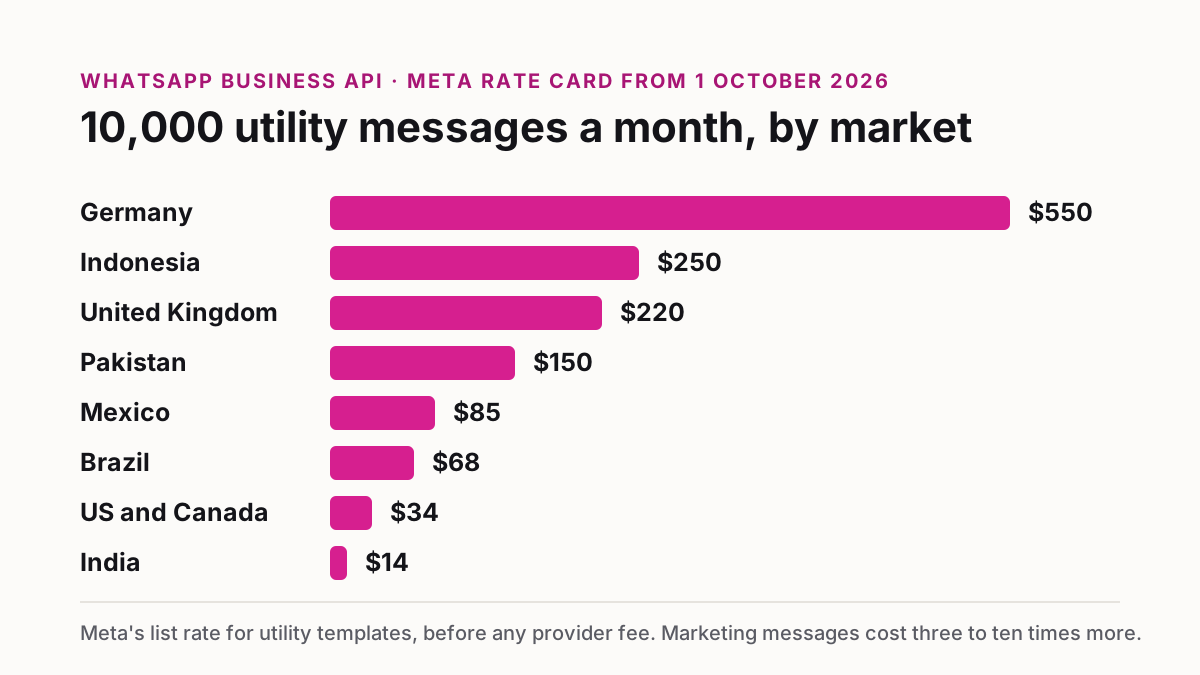
Meta prices every message by category and by the recipient's country. 10,000 order updates cost $14 in India, $34 in the US and $550 in Germany. Replies are free up to 1,000 a month per number, then charged. For alerts people expect, a flat-fee API such as ChatRail is cheaper past a few thousand messages a month. For marketing to big lists, use Meta.
How Meta prices a message

Meta's WhatsApp Business Platform, the official API, charges per message delivered. Since the rate card effective 1 October 2026, the price depends on two things: the category of the message and the country of the phone number you send it to. There are five categories:
| Category | What it covers | Who starts it |
|---|---|---|
| Marketing | Offers, promotions, re-engagement, anything that sells. | You |
| Utility | Order updates, delivery notices, reminders, account alerts. | You |
| Authentication | One-time passcodes. A higher authentication-international rate applies in some markets when the business is based elsewhere. | You |
| Service | Free-form replies inside the 24-hour window that opens when a customer messages you. | The customer |
| Meta Business Agent | Meta's own AI agent answering in your chats, priced per million tokens rather than per message. | The customer |
Marketing, utility and authentication messages must use a template that Meta has approved before you can send it. Service messages do not, but you can only send them while the customer's 24-hour window is open.
What is free
Meta's page lists exactly two cases where a message costs nothing:
- The free entry point window. When a customer reaches you through a click-to-WhatsApp ad or a Facebook Page call-to-action button, every message you send for the next 72 hours is free, whatever the category.
- The first 1,000 service messages a month, per business phone number. The 1,001st reply is charged at the service rate. Unused free messages do not roll over to the next month.
One thing stopped being free on 1 October 2026: utility templates sent inside the 24-hour customer service window. They used to ride along at no cost. They are now charged at the utility rate like any other utility message, and Meta's webhooks report them as regular rather than free.
The rates in ten markets
Per delivered message, in US dollars, from Meta's list-rate file effective 1 October 2026. Authentication and service cost the same as utility in every market here. The US and Canada share one rate; Meta lists them as North America.
| Market | Marketing | Utility | Authentication | Auth (international) | Service |
|---|---|---|---|---|---|
| US and Canada | $0.0250 | $0.0034 | $0.0034 | n/a | $0.0034 |
| United Kingdom | $0.0635 | $0.0220 | $0.0220 | n/a | $0.0220 |
| Germany | $0.1365 | $0.0550 | $0.0550 | n/a | $0.0550 |
| Brazil | $0.0625 | $0.0068 | $0.0068 | n/a | $0.0068 |
| Mexico | $0.0397 | $0.0085 | $0.0085 | n/a | $0.0085 |
| India | $0.0118 | $0.0014 | $0.0014 | $0.0304 | $0.0014 |
| Indonesia | $0.0411 | $0.0250 | $0.0250 | $0.1360 | $0.0250 |
| Pakistan | $0.0473 | $0.0150 | $0.0150 | $0.0750 | $0.0150 |
| Nigeria | $0.0516 | $0.0067 | $0.0067 | $0.0750 | $0.0067 |
| United Arab Emirates | $0.0576 | $0.0157 | $0.0157 | $0.0510 | $0.0157 |
Two patterns stand out. First, marketing costs three to ten times more than utility everywhere, so getting a message classed as utility rather than marketing matters. Second, the gap between countries is enormous: a utility message to Germany costs 39 times one to India.
Meta prices 47 markets individually and maps every other country to a region such as Rest of Africa or Rest of Latin America. On 1 October 2026 nine countries moved out of those regions onto their own rates, and Pakistan's utility rate went up for the second time in 2026, so check your own market rather than assuming last year's number.
A worked monthly bill
Take an online shop that sends 10,000 order and delivery updates a month (utility), 2,000 login codes (authentication) and 5,000 replies to customer questions (service). The first 1,000 replies are free, so 4,000 are charged. Meta's fee alone, at list rate:
| Market | 10,000 updates | 2,000 codes | 4,000 paid replies | Meta's bill |
|---|---|---|---|---|
| India | $14 | $2.80 | $5.60 | $22.40 |
| US and Canada | $34 | $6.80 | $13.60 | $54.40 |
| Brazil | $68 | $13.60 | $27.20 | $108.80 |
| Pakistan | $150 | $30 | $60 | $240 |
| Germany | $550 | $110 | $220 | $880 |
That is before your provider's fee. Meta sells the API directly through its Cloud API, but most teams buy through a Business Solution Provider such as Twilio or 360dialog, which adds its own per-message fee or a monthly platform charge. Our comparison page lists what each one publishes.
Volume discounts exist, but only for utility and authentication messages, and the first tier starts at tens of thousands of messages a month in most markets. A small team pays list rate.
When a flat fee is cheaper
Linked-device APIs connect to a regular WhatsApp number the way WhatsApp Web does. There is no per-message fee and no template approval; you pay a flat monthly price for the number. ChatRail's Core plan is $15 a month for one number with unlimited sending, and replies are included.
Divide $15 by Meta's utility rate and you get the monthly volume where the two cost the same. Above it, the flat fee wins:
| Market | Meta utility rate | Messages a month where $15 breaks even |
|---|---|---|
| US and Canada | $0.0034 | 4,412 |
| United Kingdom | $0.0220 | 682 |
| Germany | $0.0550 | 273 |
| Brazil | $0.0068 | 2,206 |
| India | $0.0014 | 10,714 |
| Pakistan | $0.0150 | 1,000 |
A linked-device API has no green tick, WhatsApp's rules on unsolicited messages still apply, and a session can drop and need pairing again. Those trade-offs, and when Meta's platform is still the right choice, are in the country pricing post.
Check the numbers yourself
ChatRail sells a flat-fee linked-device WhatsApp API, so we have a stake in this comparison. Every Meta figure above is from Meta's WhatsApp Business Platform pricing page and the USD list-rate file linked from it, opened on 19 October 2026. Rates change; the card used here took effect on 1 October 2026. Authentication-international rates are listed on their own page.